Mooly App: Workplace Wellbeing
Mooly was created as my final Master's Thesis at Politecnico di Milano, a Top Global Design University. It's a comprehensive Product Service System (PSS) designed to tackle corporate emotional exhaustion.
Moving beyond basic meditation apps, Mooly explores a new approach using a seamless interface to connect individual stress monitoring with collective psychological safety in enterprise environments.

Intro
Problem
Post-pandemic, 52% of employees report chronic burnout, yet existing corporate wellness solutions (like meditation apps) often fail due to high cognitive load and lack of personalization. Employees are expected to manage their stress in isolation, leading to a disconnect between individual well-being and company culture. The challenge was: How might we design a seamless, emotionally intelligent system that supports employees during stressful situations without burdening their daily workflow?
Solution
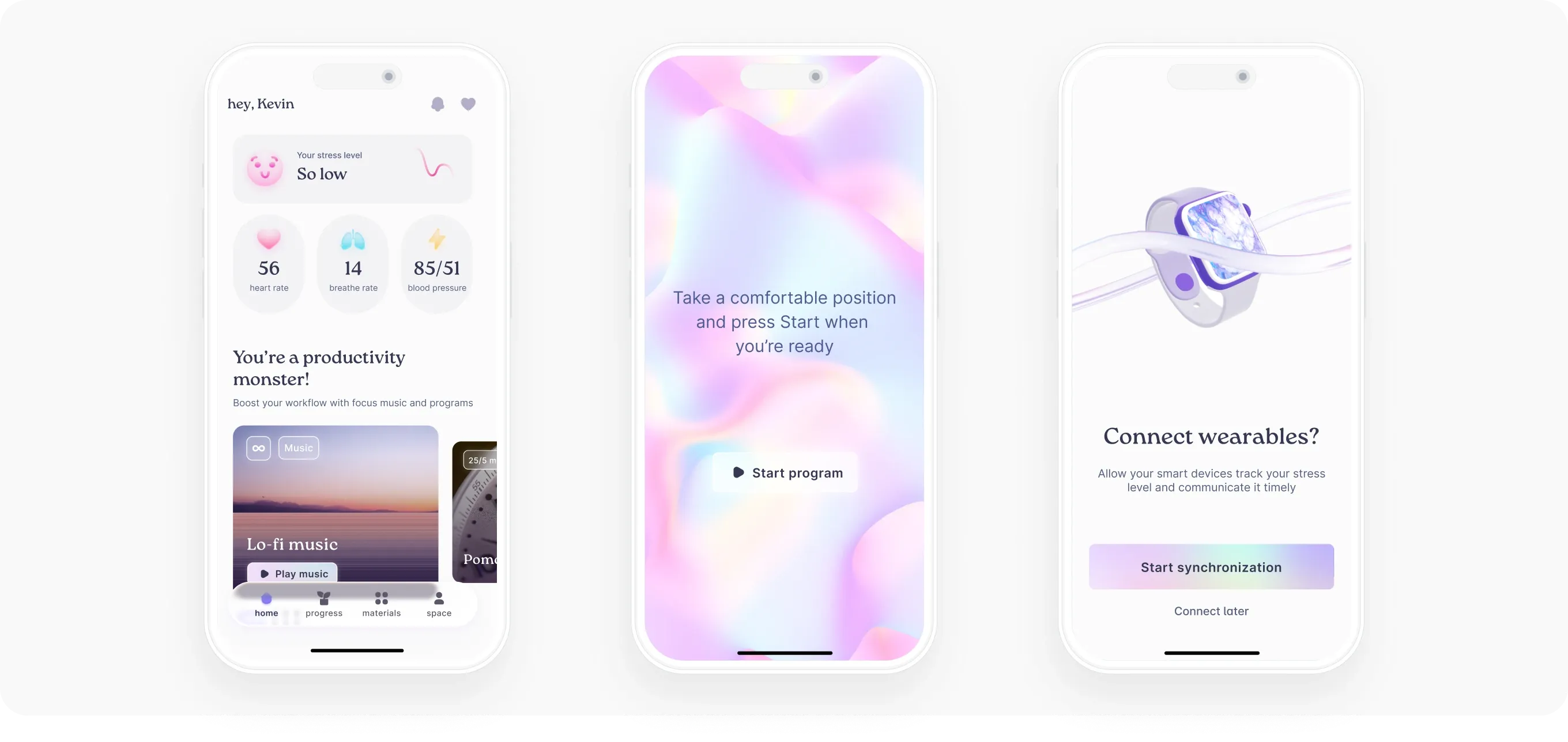
Mooly is a cross-device Product-Service System (PSS) that acts as an empathetic digital mentor. Instead of forcing users to build complex new habits, the app leverages real-time biometric data (via wearables) to detect stress spikes and offers micro-interventions on the fly. The core innovation is the "Buddy Program", a feature that shifts stress management from a solitary task to a community-driven experience, encouraging coworkers to take synchronized, guilt-free recovery breaks.
Outcome
77% Overall Usability Score
(satisfying 130 out of 236 strict heuristic criteria)
The high-fidelity prototype successfully validated its enterprise readiness without the need for immediate live user testing
Discover & Define
Approach
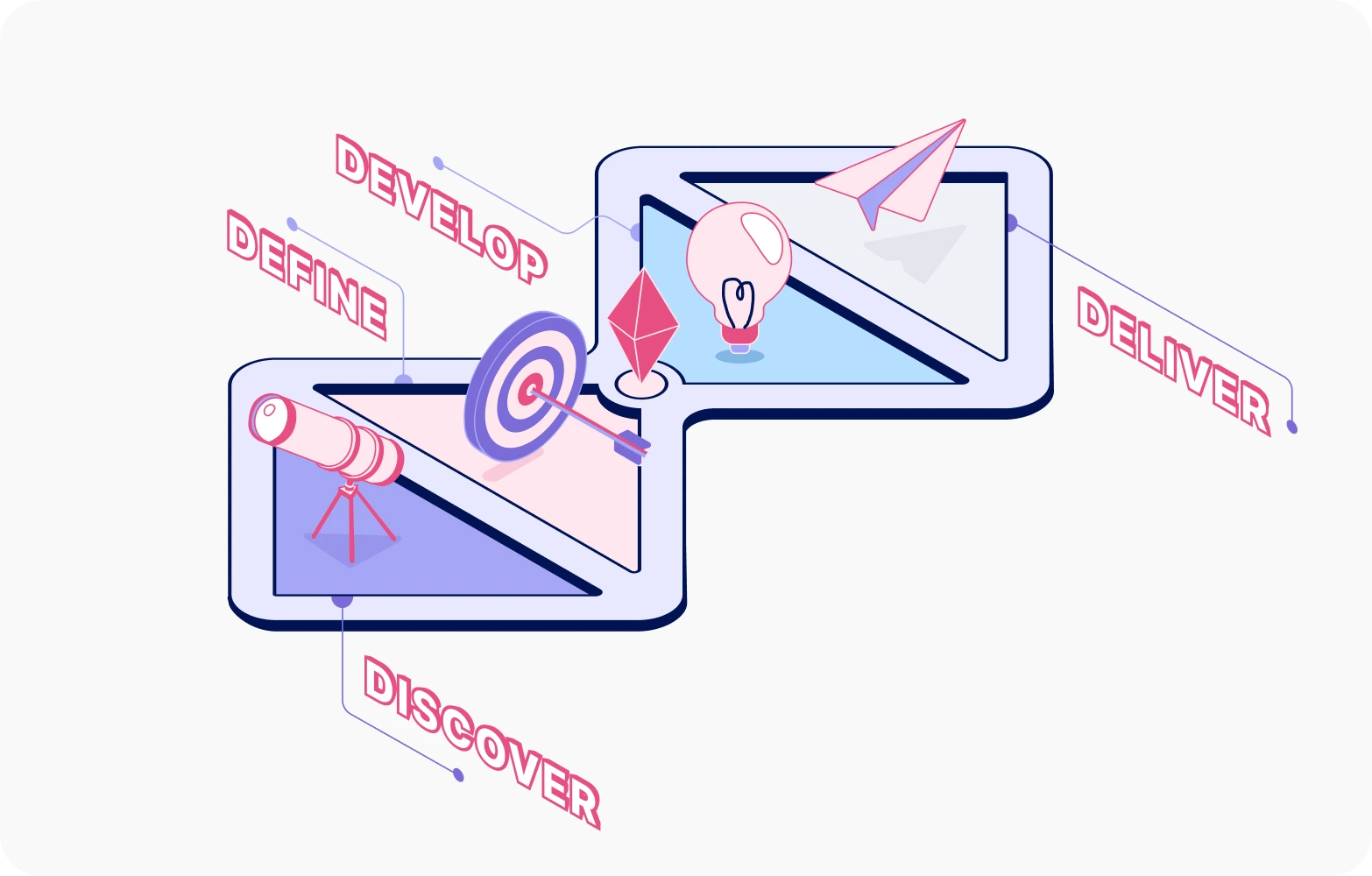
I utilized the Double Diamond methodology to structure the chaos of corporate burnout. This framework provided a clear path from deep, empathetic user discovery to focused prototyping ensuring the final product was driven by actual employee behaviors, not assumptions.
Survey & Interviews
To validate my initial hypotheses and build empathy, I conducted a survey (75+ responses) and deep-dive 1-on-1 interviews with corporate employees. Discovered that despite 88% reporting burnout, users abandon mindfulness apps due to "lack of time" and "high cognitive load." Stress management cannot feel like another burden.
Competitor Analysis
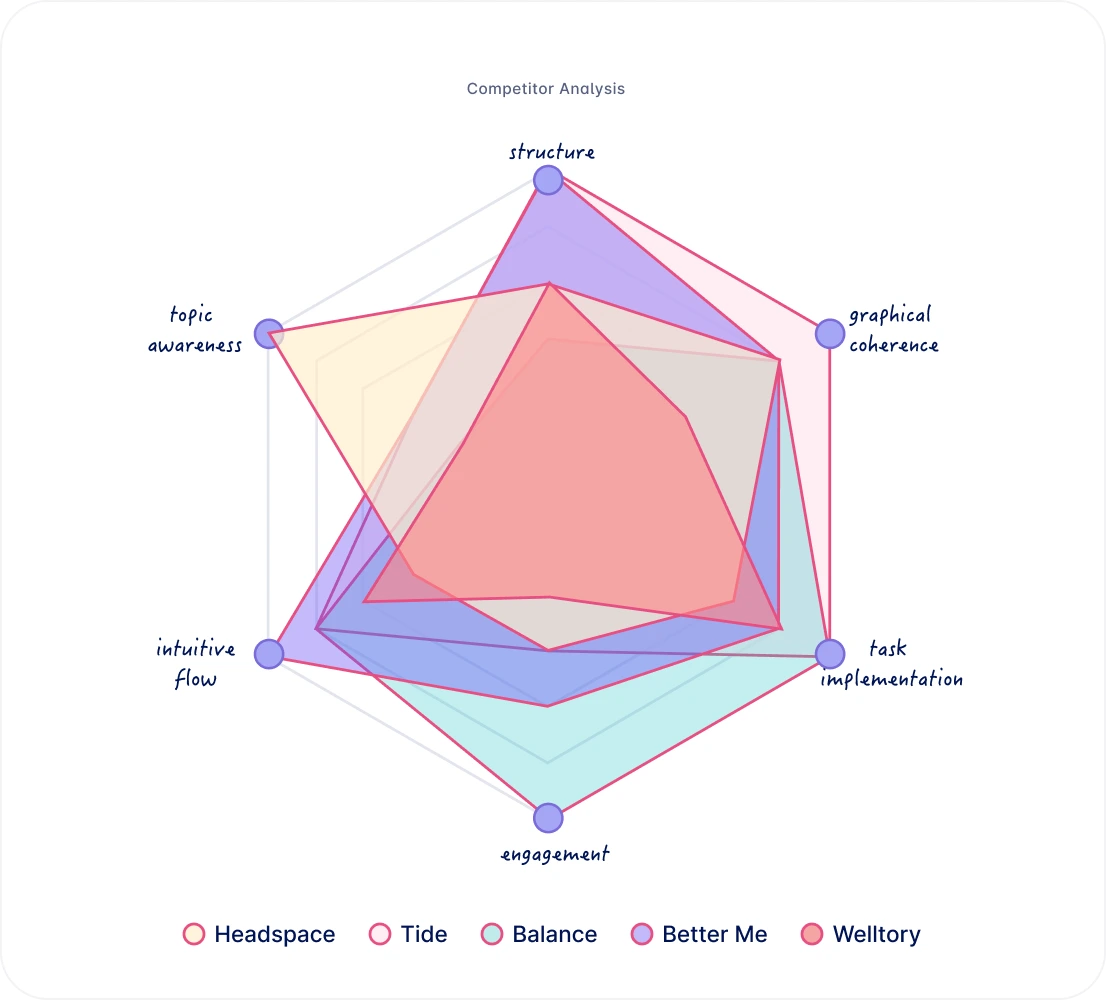
I evaluated 6 leading market solutions (Headspace, Welltory, etc.) across key UX dimensions using a custom Radar Chart matrix to identify market gaps. Revealed that current B2C apps are purely individualistic, completely ignoring the crucial interpersonal and community support needed in a workplace environment.
Design
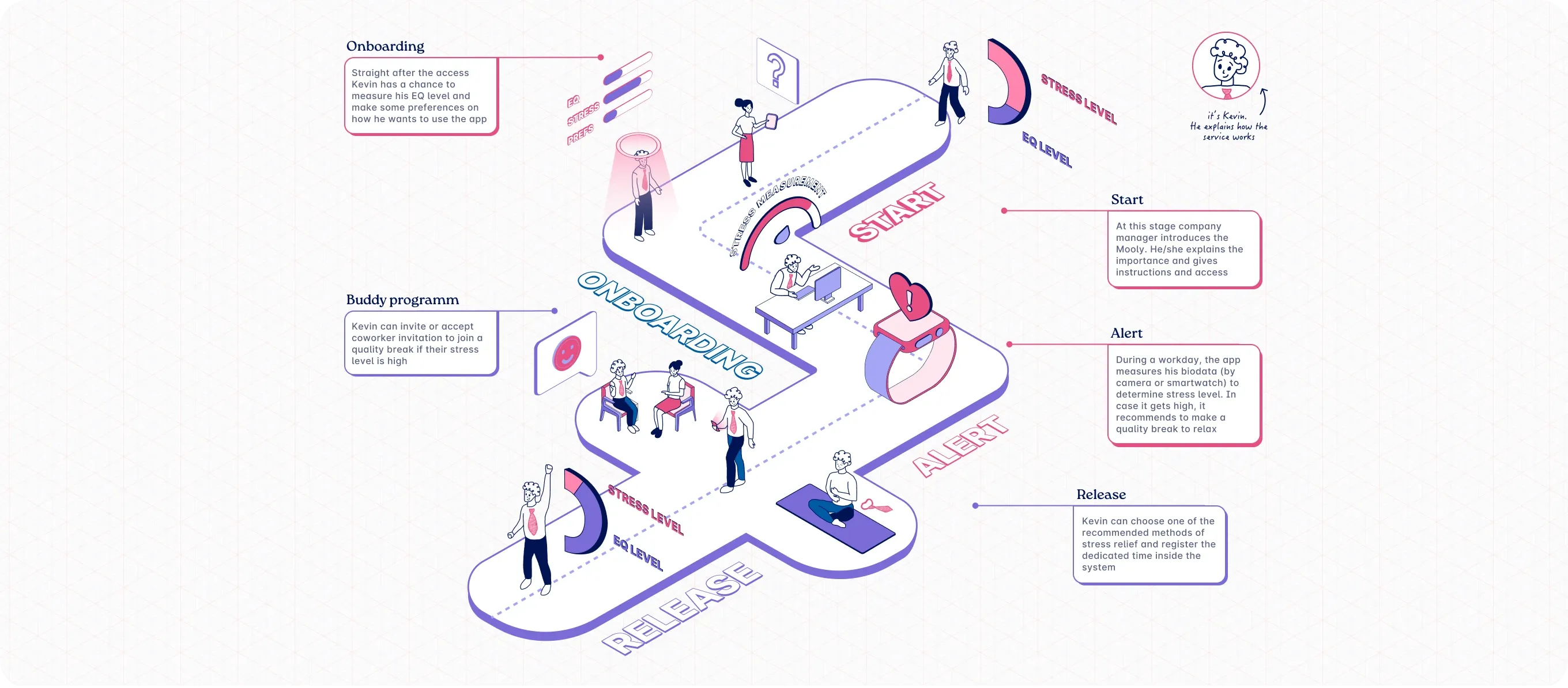
Service Blueprinting & User Journey
To transform isolated app interactions into a seamless corporate ecosystem, I developed a comprehensive Service Blueprint. This mapped the entire user journey - from wearable stress detection to HR analytics. As a result - creation of a holistic Product-Service System (PSS) that automatically intervenes during high-stress moments without adding cognitive load to the employee's workflow
Information Architecture & Wireflows
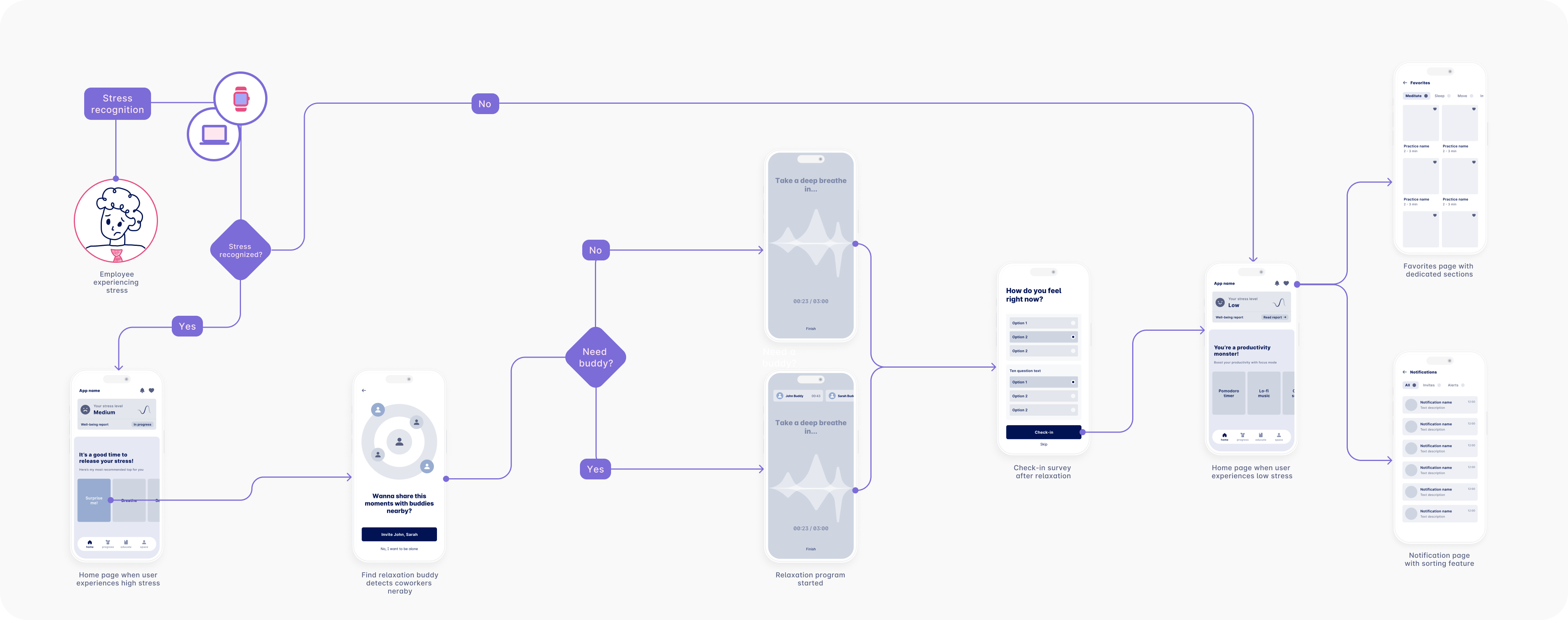
Based on the blueprint, I structured the Information Architecture and designed low-fidelity wireflows focusing on zero-friction navigation. The goal was to make finding and initiating stress-relief routines as effortless as possible for cognitively exhausted users. Established a clear, intuitive hierarchy that balances deep personal analytics with quick, actionable mindfulness tools, ensuring users never feel lost or overwhelmed.
Prototyping the "Buddy Program"
To solve the critical lack of workplace community support identified in research, I conceptualized and prototyped the "Buddy Program." This core feature detects nearby colleagues with elevated stress levels and prompts them to take synchronized, guilt-free recovery breaks.
Deliver: Branding
Visual Identity & Brand Direction
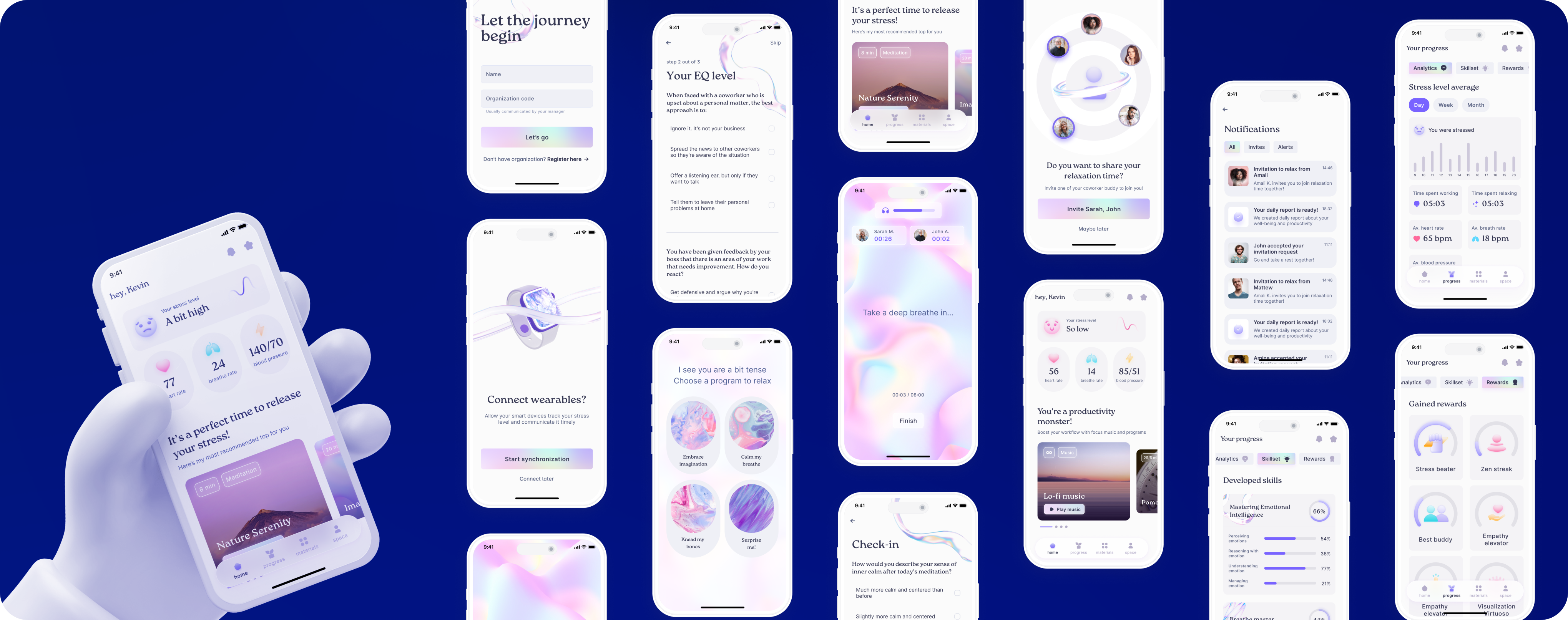
To contrast the high-stress corporate environment, I designed a brand identity rooted in "Ethereal Zen" and the calming twilight hours of nature. The goal was to make the app feel like a gentle, unobtrusive friend rather than another demanding corporate tool.
Tone of Voice & Microcopy
I defined a "Warm, Conscious, but Easy" communication style. Mooly speaks to users with empathy and honesty, acknowledging their stress without forcing toxic positivity or spiritual cliches.
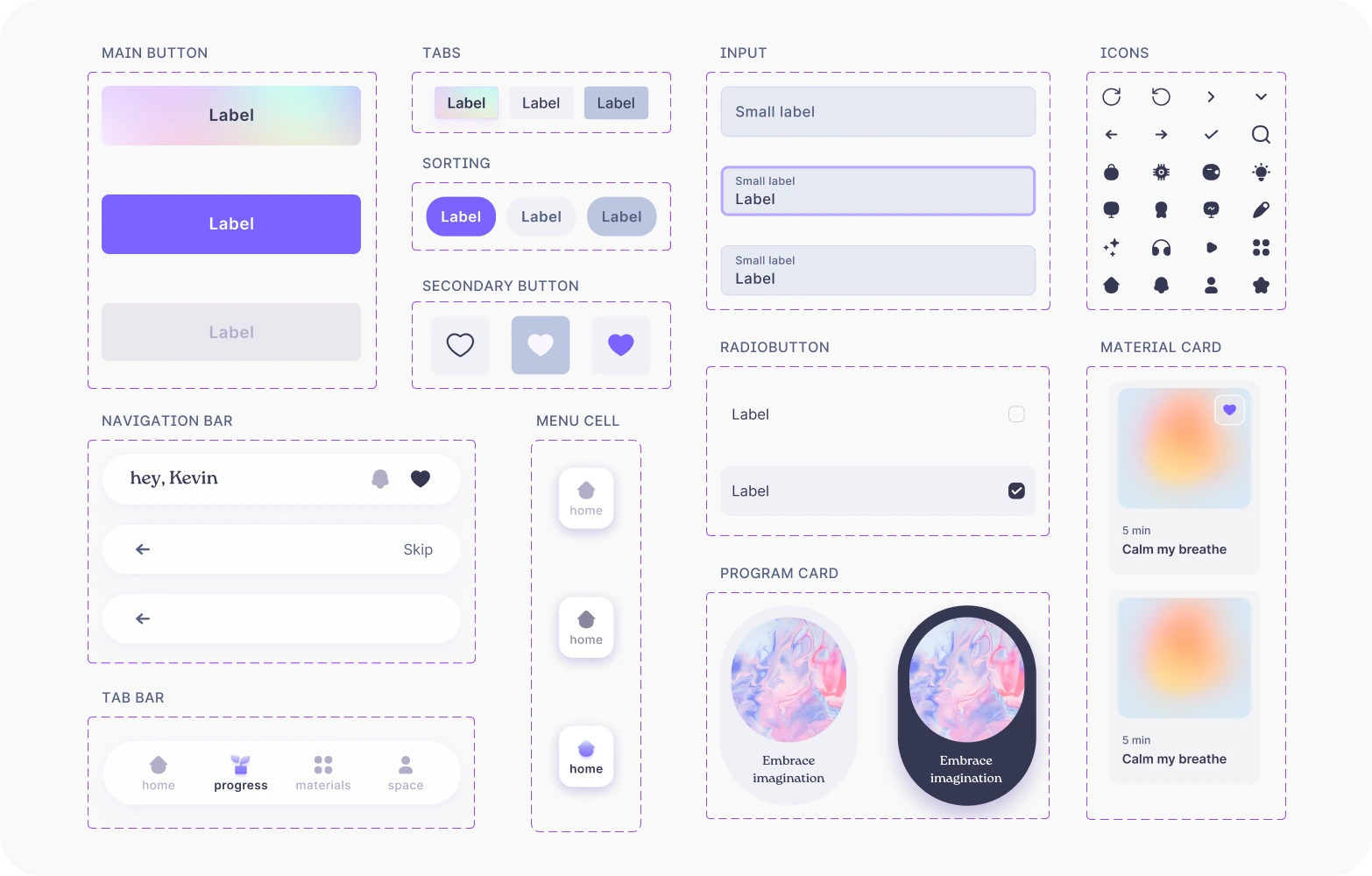
Scalable Design Library
To ensure consistency across the entire Product-Service System, I built a comprehensive, tokenized UI kit. Every component from soft-edged cards to accessible typography was designed to minimize cognitive load.

Deliver: Validation
Adaptive Heuristic Evaluation
While standard UX audits rely on 10 basic Nielsen heuristics from the 1990s, I needed a more rigorous framework to validate a complex, cross-device mobile application without live user testing constraints.
The Action: I adapted and expanded classical heuristics specifically for mobile ergonomics and emotional interfaces, creating a comprehensive checklist of 236 strict usability criteria
The Result: The high-fidelity prototype was systematically audited, achieving a 77% Overall Usability Score (satisfying 130 core principles), with standout ratings in Aesthetic Minimalism (90%) and System Consistency (91.2%), proving the concept is robust and enterprise-ready.
Future Horizon & Ecosystem Growth
Beyond the current MVP, Mooly is designed to scale. The next evolutionary step considered developing advanced backend analytics for HR and corporate psychotherapists, providing them with anonymized, aggregate data to identify organizational stress patterns.
Personal Reflections
Mooly is more than just a conceptual case study: it represents the culmination of my Master's degree in Product Service System Design (PSSD) at Politecnico di Milano and years of hands-on UX experience.
It was a profound challenge to translate the highly subjective, deeply human concept of "emotional intelligence" into a structured, scalable digital product. This project pushed me to synthesize everything I've learned about empathetic research, complex system architecture, and aesthetic minimalism.